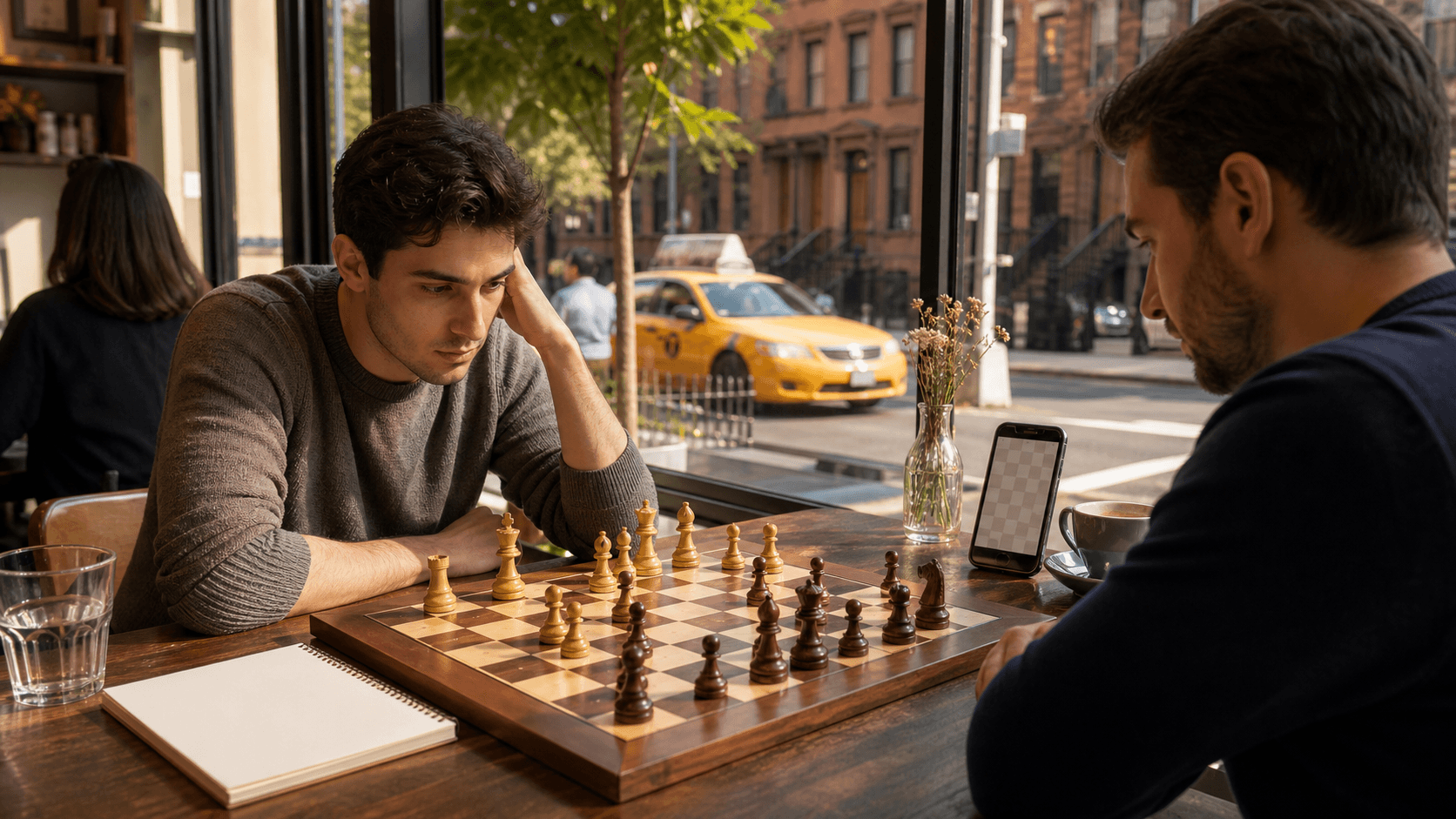
Turn Online Blitz Habits Into Over-the-Board Confidence
If you spend your evenings grinding 3+0 or 5+0 blitz or bullet, but have never sat for a long, quiet, rated game in Manhattan, you are not alone. Many adult players reach a point where online ratings feel flat, and the next step is a real USCF classical event with a physical board, a scoresheet, and a clock that actually gives you time to think. That first step can feel scary, especially when you hear words like "sections," "pairings," and "provisional rating."
At United States Chess Academy, we see adult students make this leap all the time, especially those in our current adult weekly classes and training groups who are preparing for the upcoming Manhattan weekend Swiss tournaments on our program calendar. Going from online blitz to a 90+30 or similar USCF time control is a skill you can learn, not a mystery you are supposed to already understand. Below, we connect directly to what our adult students are working on right now in class: how USCF ratings work, how to pick the right Manhattan tournament and section from our current recommendations, what changes in your thinking when you move from blitz to classical, and how to use a simple 4‑week prep plan that lines up with our present class cycles and tournament schedule.
How USCF Ratings Really Work for Adult Beginners
When you play your first USCF tournament, you start without a rating. After your first few official games, the USCF system gives you a provisional rating based on your results and the ratings of your opponents. During this early stage, your number can move a lot, because the system is still "figuring you out." A strong event or a rough weekend can swing that first rating up or down quite quickly, and that is completely normal.
In our current adult classes, we walk through this process step by step, using real examples from recent Academy tournament results so you can see exactly how a first rating is formed and how it stabilizes over a few events.
Online ratings from sites like Chess.com or Lichess do not match USCF ratings in a clean, one‑to‑one way. Different pools of players, different time controls, and different rating formulas all play a part. Someone with a 1500 blitz rating online might end up higher or lower in USCF classical, and adults who start tournaments later in life sometimes need a few events before their classical strength really shows.
Many adults worry about things like:
- What if I lose every game in my first event?
- What if my rating is "too low" for a Manhattan tournament?
- What if everyone there takes it more seriously than I do?
The truth is, starting with losses, draws, and messy games is very common. Many of our adult students begin exactly this way. In our current rating and tournament‑skills units, we also help adults measure progress in ways that are not just about rating. We look at how well you manage your time, how you handle nerves, whether you recognize key patterns, and how your decisions in critical positions improve from one event to the next.
If you like to train online, our coaches are presently blending that with structured work using online lessons and our ongoing adult group classes, so your internet games and your over‑the‑board goals support each other as you head into the next round of local tournaments.
Choosing the Right Manhattan Tournament and Section
Right now, Manhattan has a steady flow of USCF events that adults can join, including several we are highlighting in our current newsletter and program schedule. You will see:
- Weekend Swiss tournaments with several rounds over one or two days
- Weeknight events where you play one long game after work
- Special seasonal events and local classics, including ones at well‑known clubs and schools that we are recommending to our adult students this cycle
Sections are there so you can face players roughly around your level. Typical rating sections look like:
- Under 1200: good for first‑timers, true beginners, and nervous returners
- Under 1600: for players with some experience and a stable opening set
- Under 2000: for more advanced club players
- Open: players of all strengths, often including titled players
If you have never played USCF classical, a safe rule is to start in a lower section than you think you "deserve." For many online blitz grinders, that often means Under 1200 or Under 1600 at first. You can always move up later when you feel your classical game is settled.
In our adult coaching at United States Chess Academy this month, we are:
- Reviewing students' online games and unrated over‑the‑board results from our in‑house practice nights
- Talking through nerves and goals in class, especially for those targeting the upcoming weekend Swiss events we list in the newsletter
- Matching players with specific Manhattan events and sections that suit their schedule and comfort level, drawn from the current tournaments highlighted in our program schedule
We keep an eye on local choices, including the Manhattan tournaments we are actively recommending, school programs that welcome adults, and larger Swiss tournaments in the city. Many of our students pair a camp or training block, such as sessions related to our current Central Park camp dates, with a nearby tournament, so practice and competition line up in a clear, intentional way.
Rewiring Your Game From Blitz Tactics to Classical Thinking
Online blitz rewards speed, surprise tactics, and practical tricks. USCF classical games ask for something different. The clock gives you time to build a plan, evaluate positions carefully, and commit to deeper calculations. Instead of "move fast and flag them," the mindset becomes "use my time, trust my thinking, and play a complete game."
These are exactly the skills we are emphasizing in our current adult curriculum unit on classical play. Three areas often feel shaky for blitz‑heavy players in their first classical event:
- Structured openings
Blitz players often rely on quick tricks or random setups. Classical chess punishes that. You do not need a giant opening book, but you do need simple, clear systems you trust against common replies. In class, we are currently focusing on a small, practical opening repertoire that you can use both in online training games and in the upcoming tournaments on our calendar.
- Consistent endgames
In blitz, many games end in time scrambles or wild attacks. In classical, you will see more endgames where basic king and pawn technique, simple rook endings, and active king play decide everything. Our adult groups are now doing weekly endgame labs using positions taken from recent student tournament games.
- Disciplined time management
Online, you are used to instant moves and mouse speed. Over‑the‑board, you must pace yourself, avoid both rushing and time trouble, and use the clock as a tool, not a threat. Time‑use checklists and practical clock drills are part of our current class cycle for adults preparing for their next USCF event.
In our adult classes and private lessons, we are tying these themes directly to the tournaments and practice matches happening this month by:
- Analyzing model games with the same time controls you will see in the highlighted Manhattan events
- Playing training games at those time controls with real notation, just as you will do at the board
- Running coach‑guided post‑mortems after class and practice nights so you learn from your own decisions in a setting that mirrors tournament conditions
The goal is simple: turn your sharp but chaotic blitz instincts into a calm, repeatable decision process that holds up over several hours at a real board, precisely what you will need for the tournaments currently on our Academy calendar.
Your 4‑week Adult Prep Plan for a First USCF Event
You do not need to overhaul your entire life to get ready. With a focused four‑week plan, even a busy Manhattan adult can feel prepared walking into that first event. This plan is designed to line up with our present four‑week adult class cycle and the upcoming tournaments featured in our newsletter.
Week 1: Openings and Schedule
- In class or a short private session, pick one main opening as White, something that leads to positions you like and that we are currently covering in our adult groups.
- Choose two solid defenses as Black, one for 1 e4 and one for 1 d4 or other queen's pawn setups, from the options we are recommending this cycle.
- Set a weekly chess schedule that fits your real life, maybe three shorter sessions on weekdays and one longer session on the weekend, and coordinate it with your current class or lesson times.
- Use class homework and our current study sheets to make sure your choices are realistic and easy to remember.
Week 2: Shift to Longer Time Controls
- Start playing online games at 15+10 or 30+0 at least a few times a week, matching the training time controls we are using in class.
- After each game, quickly annotate it: where you felt unsure, where you rushed, where you spent too long.
- Bring one or two of these games to your adult class or private lesson for review.
- Join one of our current practice nights at the Academy (or a recommended local club) for a training game at the same speed you expect in your upcoming tournament.
Week 3: Endgames, Calculation, and Time Use
- Spend short daily sessions on the basic endgames we are drilling this month in class: mate with king and rook, simple king and pawn endings, and common rook endgame themes.
- Do simple calculation drills: pick a position from our current class handouts, calculate three moves deep without moving the pieces, then check yourself.
- Practice time management in online longer games: set mini‑goals like "reach move 20 with half my time left," just as we practice in our adult workshops.
- If possible, play one or two live games with a real board and scoresheet at the Academy or a local club to feel the rhythm before the specific weekend event you are targeting.
Week 4: Full Rehearsal and Logistics
- Play at least one full classical training game at your target time control, with notation and a real clock, during our current practice night or in a scheduled training game with a classmate.
- Review that game with a coach, focusing on handling nerves and critical moments, as we are doing in our pre‑tournament review sessions this cycle.
- Confirm your USCF membership, register for the tournament we have identified together in class, and plan your route and food for the day.
- Do a short mental checklist: accept that nerves are normal, remind yourself to write moves clearly, and plan a simple routine between rounds, like a short walk or checking in with fellow Academy players who are at the same event.
If you like structure, you can use the Academy's current class cycles and the events listed in the program schedule as anchors for this four‑week plan. For example, many adult students are timing this plan so Week 4 ends right before our next highlighted Manhattan weekend Swiss.
Why Local Coaching Makes Your First Tournament Fun
The chess itself is only half of your first classical event. The other half is emotional. Many adults feel impostor syndrome when they walk into a room full of boards, clocks, and focused players. There is the fear of making a "beginner mistake" in front of strangers, or not knowing when you can offer a draw or go to the bathroom.
Because our current adult groups include many players on this exact path, you are not doing it alone. When you work with a regular coaching team and a group of peers who are also preparing for the same upcoming tournaments, that pressure drops. Our chess coaching for adults in Manhattan lets you rehearse not just moves, but experiences: setting the clock, filling out a scoresheet, saying "I offer a draw," and handling losses without letting one bad game ruin your entire event.
In our present training cycle, we connect directly to what you will face at the board:
- Remembering your opening lines when your heart is racing in the early rounds of the tournaments on our schedule
- Managing clock trouble without panic, using the same time‑management tools we practice in class
- Bouncing back between rounds with a clear head, often with support from classmates playing in the same event
Over time, that first USCF classical tournament stops being a scary unknown and becomes a story you tell with a smile. It is the moment when late‑night blitz sessions turned into something bigger, a steady, real‑world chess habit built around boards, clocks, and a community of other adults doing the same thing in Manhattan, in step with the classes, camps, and tournaments we are running right now at United States Chess Academy.
Advance Your Chess With Personalized Adult Coaching
If you are ready to turn casual play into confident, strategic chess, we are here to help. Explore our tailored chess coaching for adults in Manhattan and work directly with experienced instructors at United States Chess Academy. We will assess your current level, clarify your goals, and create a focused plan so each session moves you closer to the player you want to be. Have questions or need help choosing the right option for you? Simply contact us and we will guide you through your next steps.